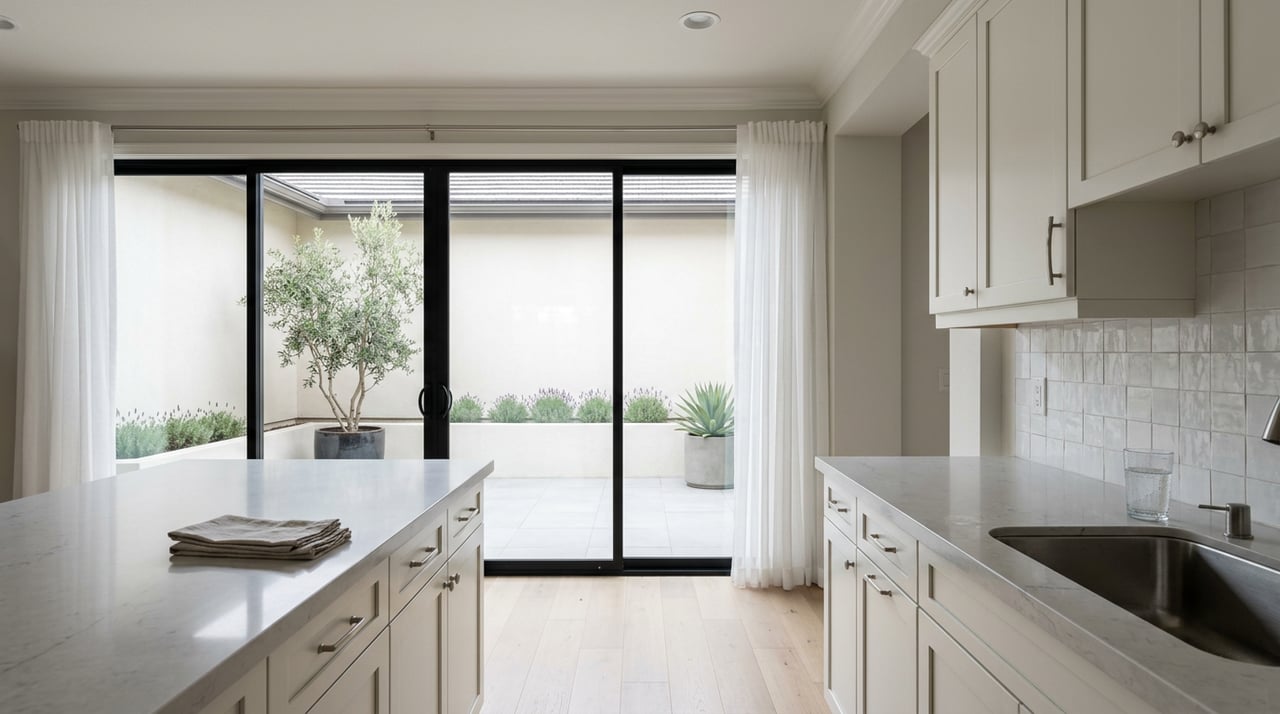
Mission Viejo went up fast. The Mission Viejo Company broke ground in 1966 with Deane Homes, 732 houses that sold before some of them were even framed, and from there the pace never really slowed. By the late 1980s, more than 34,000 homes had gone up across what are now the 92691 and 92692 zip codes. That speed is part of why the city reads as one of the most cohesive master-planned communities in the country. It's also why so many of those homes are approaching the end of their original plumbing at almost exactly the same time.
That timing detail matters more to a home sale than most sellers realize. It doesn't just mean a pipe might fail. It means the plumbing question in Mission Viejo behaves less like a maintenance issue and more like a pricing variable, one that shows up differently depending on which tract you're in and one that the citywide numbers don't account for at all.
The Same Decade, Block After Block
Walk through the older half of the city and the plumbing history is legible almost by street name. The earliest tracts, Cordova, Highland Park, the Country Club area, and Baja Oso, went up between 1966 and 1972 and still carry a mix of galvanized steel, early copper, cast iron drains, and clay sewer laterals, the oldest plumbing stock in the city. Deane Homes, the very first neighborhood the Mission Viejo Company built starting in 1966, shares that same original galvanized steel across its 732 houses. La Paz and El Dorado, dating to the late 1960s, tell a similar story: a share of those homes still run on original galvanized supply lines, identifiable by rusty water and pressure that keeps dropping. Barcelona, Aegean Hills, Madrid, and the stretch of homes along Marguerite Parkway came a few years later, in the 1970s, with copper supply lines and cast iron drains, a slightly younger system but one that's now approaching fifty years of exposure to hard water.
The practical effect is that a buyer's inspector isn't finding a random old pipe here and there. They're finding a system that was installed in a specific decade, shared by every other house on the block, and now sitting at the exact age where failure becomes likely rather than possible.
The Water Isn't Helping
Age alone would be a slow-moving problem. What speeds it up in Mission Viejo is the water itself. The city's supply, delivered through Moulton Niguel and El Toro Water Districts, runs moderately hard, and that mineral content coats pipe interiors, reduces water heater efficiency, and accelerates the pinhole corrosion that eventually turns into a leak. Add in the region's clay and sandy loam soil, which expands and contracts with seasonal moisture and shifts incrementally during seismic activity, and underground joints separate over time in ways that don't announce themselves. A worsening sewer backup or an unexplained drop in water pressure weeks after a minor earthquake often traces back to exactly this kind of movement.
None of this is unique to one address. It's a citywide condition sitting quietly under a citywide housing stock that was built inside a narrow window.
What This Actually Costs, and Where Sellers Get Caught
The failure pattern that catches people off guard isn't the first leak. It's the third one. A common trajectory for owners of original-plumbing homes in South Orange County looks like this: a leak gets patched for a few hundred dollars, then another, then a slab leak that requires cutting concrete, and by the time an owner has spent $6,000 to $10,000 on piecemeal repairs, a whole-home repipe quote lands somewhere between $25,000 and $33,000. One documented case in the area involved a homeowner who had already dealt with two slab leaks in three years, had her floors torn up twice, and was quoted $31,000 for a full repipe. A second opinion from a repiping specialist brought the same job in at $11,000 with a lifetime warranty.
That gap matters for a seller because it's exactly the number a buyer's agent will bring back to the negotiating table after an inspection flags galvanized or original copper supply lines. A seller who understands their tract's likely plumbing status before listing can price around it, disclose it accurately, or repipe preemptively and use the upgrade as a selling point. A seller who finds out during escrow is negotiating from a weaker position, often against a credit request based on the higher end of that repair range rather than the specialist rate.
Why a Delay Here Costs More Than It Used To
Mission Viejo's market in 2026 has little patience for a listing that stalls. Homes that sit past the first two weeks without an offer start reading as flawed to buyers, regardless of whether the actual issue is pricing or a paint color. That shift changes how a mid-escrow plumbing surprise plays out. A repipe negotiation that reopens the deal, or worse, sends a buyer walking, can push a home past that early window and into the stigma zone, where even a fully justified price adjustment doesn't undo the perception that something's wrong.
In a market where buyers move fast on properties priced right and lose patience with anything that feels uncertain, a known plumbing issue disclosed upfront is a manageable line item. The same issue discovered in week three of escrow is a listing problem.
The Number That Actually Moves With Your Address
There's a second, related distortion worth understanding before you set a price, and it comes from how differently the major data sources measure home values in this city right now.
| Source | Measure | Figure (June 2026) |
|---|---|---|
| Zillow Home Value Index | Estimated value across entire housing stock | Approximately $1,067,000, up 0.7% year over year |
| MLS closed sales | Median sale price of homes that closed | $1,225,000, down 5.8% from $1,300,000 a year earlier |
| Redfin | Median sale price of homes that closed | Approximately $1,249,000, up 1.6% year over year |
The spread between these numbers isn't a data error. Zillow's model tracks value across every home in the city, including ones not currently for sale. The MLS and Redfin figures only reflect what actually closed that month, which means the mix of what sold matters. A month heavy on condo and townhome closings pulls the citywide median down even if single-family values haven't moved at all. In June 2026, single-family homes in Mission Viejo actually sold at a median of $1,370,000, around $712 per square foot, while condos and townhomes closed in the $550,000 to $810,000 range.
That split is the same mechanism as the plumbing question, just wearing a different outfit. A citywide median tells you almost nothing about what your specific home, in your specific tract, with your specific pipe vintage, should sell for. The comp that matters is narrower than the headline number, and now it has one more hidden variable inside it.
Before You List
If your home sits in one of the pre-1980 tracts, whether that's Deane Homes, La Paz, El Dorado, Barcelona, Aegean Hills, or Madrid, a plumber's assessment before you list tells you more than a general home inspector's checklist will. It's worth knowing whether you're looking at original galvanized steel, aging copper, or a system that's already been repiped, and getting a specialist's quote rather than a phone estimate if a repipe looks likely. From there the decision is straightforward: repipe and market the upgrade, or price and disclose accurately so the number on your listing already reflects reality instead of getting renegotiated three weeks in.
Getting ahead of it protects the timeline as much as the price.
A Few Questions Sellers Ask
How do I find out what kind of pipes my house has without tearing into a wall? A plumber can often identify supply line material by scratching a visible section where pipe enters the home, checking the water heater connection, or pulling permit history for the property. Combine that with knowing your tract's build decade and you have a strong starting picture.
Does repiping before selling actually pay off? It depends on the spread between your likely repipe cost and what an unresolved plumbing flag would cost you in negotiated credits, but the documented cost range for South Orange County repipes shows real quotes can vary by tens of thousands of dollars depending on who you call, so getting more than one estimate matters regardless of which path you choose.
Is a lower, faster offer ever the better move if my home has original plumbing? For some sellers, particularly those managing an inherited property or working against a deadline, trading some price for certainty and speed makes sense. For others with time and a home in solid shape otherwise, pricing accurately on the open market and disclosing clearly is the stronger path. Either way, knowing your plumbing situation before you decide is what makes the decision an informed one.
If you're weighing what your Mission Viejo home is really worth once the tract, the vintage, and the plumbing history are factored in, Maureen Muno Hensley can walk through the specifics with you. Let's Connect.
This article is general information, not legal, tax or financial advice. Consult a qualified professional about your situation.